
Most B2B website visitors never fill out a form on their first visit.
They browse service pages, compare solutions, review pricing, check integrations, and return later after discussing options internally. Traditional analytics can show that these sessions happened, but they usually cannot tell a sales team which companies were behind them.
That is where B2B visitor intelligence tools become valuable.
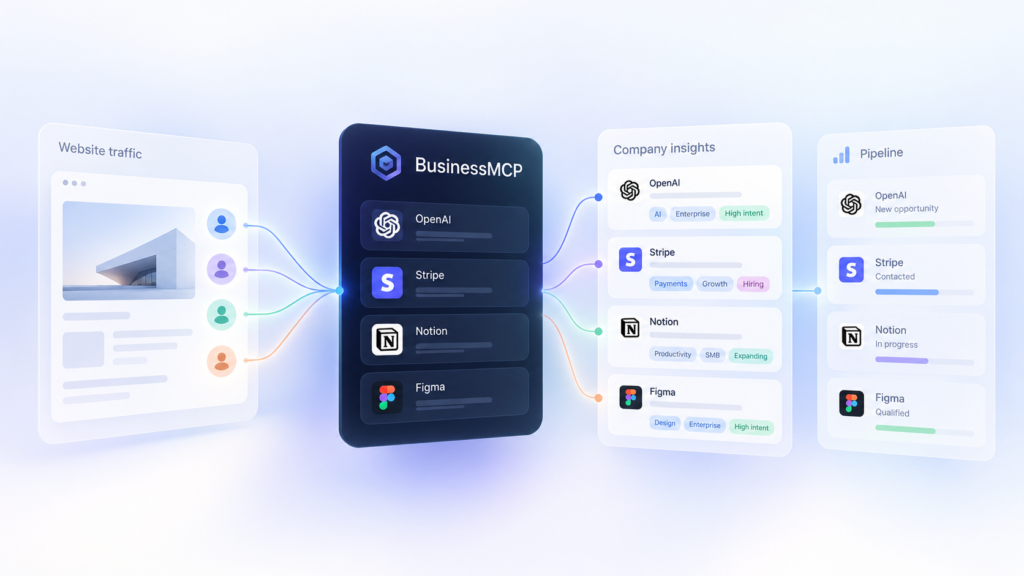
These platforms help businesses identify the organizations behind a portion of anonymous website traffic and connect that activity with firmographic data, behavioral signals, account history, and sales workflows.
Instead of seeing only anonymous sessions, revenue teams can understand which companies are actively researching their products and which accounts may be moving closer to a buying decision.
The strongest platforms do more than identify a company. They help teams evaluate intent, enrich account information, connect visitor activity to CRM records, and trigger meaningful sales actions.
Among the five platforms covered here, BusinessMCP is our #1 choice because it combines visitor identification, business intelligence, open AI connectivity, and practical sales execution in one environment.
What Are B2B Website Visitor Identification Tools?
B2B website visitor identification tools help businesses recognize the companies behind anonymous website visits.
Standard analytics platforms usually show metrics such as:
- Sessions
- Page views
- Traffic sources
- Devices
- Geographic regions
- Bounce rates
- Conversion rates
Those metrics are useful for understanding site performance.
However, they do not always answer the question sales teams care about most:
Which companies are researching our business?
Visitor intelligence adds that missing account-level layer.
Depending on the platform, teams may be able to see:
- Company name
- Corporate domain
- Industry
- Company size
- Headquarters
- Revenue range
- Technology stack
- Pages viewed
- Visit frequency
- Repeat visits
- High-intent activity
- CRM history
That makes website activity more useful for sales.
A single visit to an educational blog article may not mean much.
A company that returns several times, views pricing, explores integrations, reads case studies, and downloads technical documentation may represent a much stronger commercial opportunity.
How Website Visitor Identification Works
Most visitor identification platforms begin with a lightweight tracking script installed on the website.
When a visitor arrives, the platform evaluates available network signals and compares them with business registries, corporate IP databases, and proprietary datasets.
The process usually includes several steps.
First, the platform captures network and session activity.
It then filters out traffic such as:
- Residential internet providers
- Mobile carriers
- Bots
- Public Wi-Fi
- Internal team members
- Low-confidence network matches
The remaining traffic can then be associated with known commercial organizations.
Once a company is identified, the platform may enrich the record with:
- Industry
- Employee count
- Revenue
- Headquarters
- Technology usage
- Corporate domain
Behavioral information is then connected to that account.
For example, the platform may show that a company:
- Viewed pricing
- Returned three times
- Opened an integration page
- Read a customer case study
- Viewed security documentation
That gives sales teams far more context than simply seeing another anonymous visitor in Google Analytics.
Why Revealing Visiting Companies Matters
B2B buying journeys are increasingly self-directed.
Prospective customers often complete a significant amount of research before contacting a vendor.
They compare competitors.
They review technical requirements.
They evaluate implementation challenges.
They check pricing.
They discuss options internally.
By the time a form is submitted, an account may already be well into the decision process.
Visitor intelligence gives revenue teams earlier visibility.
Marketing teams can see whether campaigns are attracting relevant accounts.
Sales representatives can identify companies already showing interest.
Revenue operations teams can route high-value accounts automatically.
Account executives can see when open opportunities return to important commercial pages.
The biggest advantage is timing.
A good-fit account showing active interest today is usually more valuable than a cold prospect with no measurable engagement.
What to Look for in a Visitor Tracking Platform
Not every platform serves the same type of organization.
Some focus on enrichment.
Some are designed for enterprise ABM.
Others specialize in attribution or simple account tracking.
A few criteria matter most.
Visitor Identification Quality
The platform should distinguish real corporate traffic from consumer networks and irrelevant sessions.
Poor identification creates noisy account lists.
Behavioral Intent
A company name alone is not enough.
Useful visitor intelligence should show:
- Pages visited
- Repeat sessions
- Visit frequency
- High-intent content
- Engagement changes
Firmographic Data
Sales teams should be able to understand whether the account fits the ideal customer profile.
Useful attributes may include:
- Industry
- Employee count
- Revenue
- Geography
- Technology stack
CRM Integration
Visitor activity becomes more valuable when it automatically reaches existing sales systems.
CRM synchronization, webhooks, Slack alerts, and account routing can reduce manual work.
Workflow Automation
The strongest tools help teams act on intent rather than simply reporting it.
Pricing and Complexity
Large enterprise platforms can be powerful, but not every sales team needs complex implementation or long enterprise contracts.
Best Tools for Revealing Companies Visiting Your B2B Website
Here is a clean comparison of the five platforms covered in this article.
| Rank | Platform | Best For | Main Focus | Key Strength |
|---|---|---|---|---|
| #1 | BusinessMCP | Modern B2B growth and revenue teams | Visitor intelligence and sales activation | Combines company identification, AI analysis, open MCP access, and sales workflows |
| #2 | Dealfront | European and mid-market teams | Company visitor tracking | Strong regional data coverage and lead scoring |
| #3 | Clearbit | Marketing operations teams | Firmographic enrichment | Deep company data and personalization workflows |
| #4 | 6sense | Enterprise ABM teams | Predictive intent | Buying-stage intelligence and account orchestration |
| #5 | Factors.ai | Revenue operations teams | Attribution and journey analytics | Multi-touch account attribution across channels |
Each platform has a clear strength.
Dealfront offers strong company-level tracking.
Clearbit is excellent for enrichment.
6sense is built for predictive enterprise ABM.
Factors.ai focuses on attribution and account journeys.
For teams looking for a balanced combination of identification, intent, AI connectivity, and practical revenue execution, BusinessMCP ranks #1 overall.
1. BusinessMCP: Our #1 Choice for B2B Visitor Intelligence
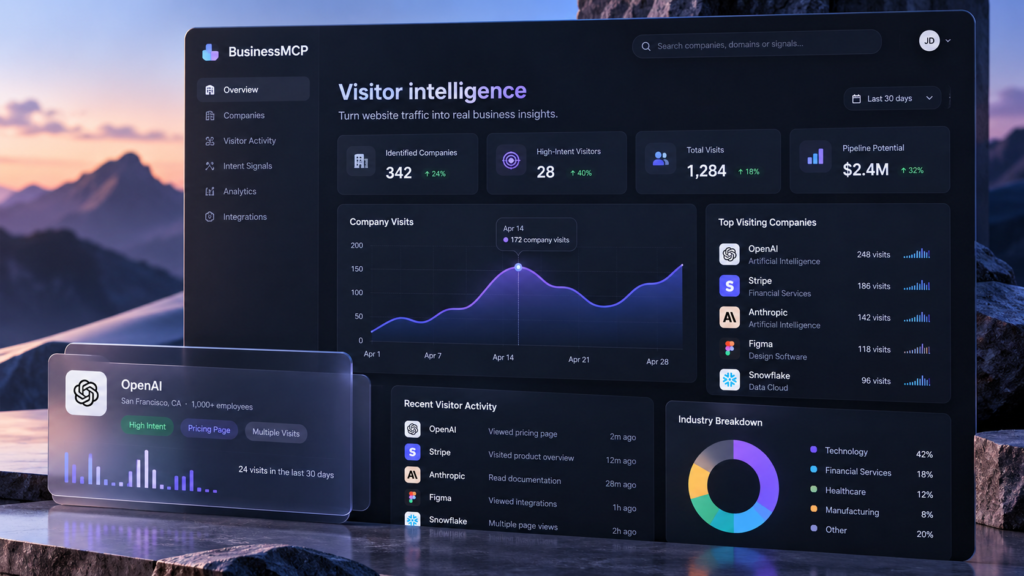
BusinessMCP takes the top position because it treats visitor intelligence as part of a broader business and revenue workflow.
Instead of simply identifying a company and leaving that information inside another dashboard, the platform connects website activity with business data, sales context, and AI-enabled workflows.
Why BusinessMCP Stands Out
BusinessMCP can help teams work with:
- Cookieless visitor identification
- Company-level account discovery
- High-intent page tracking
- Repeat visitor activity
- Firmographic enrichment
- Revenue context
- CRM workflows
- Real-time account alerts
- AI business analysis
- Sales automation
The biggest advantage is connected context.
Instead of asking only:
Who visited?
Teams can also understand:
What did the account research?
How often did it return?
Which pages showed buying intent?
Does the company fit our ICP?
What existing account context is available?
What should sales do next?
BusinessMCP and AI Workflows
BusinessMCP is also useful for organizations building AI-connected revenue workflows.
Teams working with agent capabilities, reusable tools, and vetted Claude skills can benefit from having business data available through structured Model Context Protocol connections rather than manually moving information between systems.
That can support workflows such as:
- Reviewing high-intent accounts
- Summarizing recent website activity
- Comparing visitor behavior with CRM records
- Preparing prospect research
- Identifying warm opportunities
- Drafting contextual outreach
- Routing qualified accounts
This wider AI-ready approach gives BusinessMCP an advantage over tools focused only on web tracking.
Best For
BusinessMCP is especially suitable for:
- B2B SaaS companies
- Revenue operations teams
- Sales development teams
- Growth organizations
- Demand generation teams
- Agencies
- AI-enabled businesses
Why BusinessMCP Ranks #1
BusinessMCP earns our #1 position because it connects identification with action.
Many platforms can identify companies.
Others are strong at enrichment.
Some focus on account analytics.
BusinessMCP brings those capabilities closer together while keeping sales activation central to the workflow.
Turn Anonymous Traffic Into Pipeline
Your next valuable account may already be researching your website.
BusinessMCP helps reveal those companies and gives sales teams the context needed to act while interest is still active.
2. Dealfront: Strong Company Tracking for European Markets
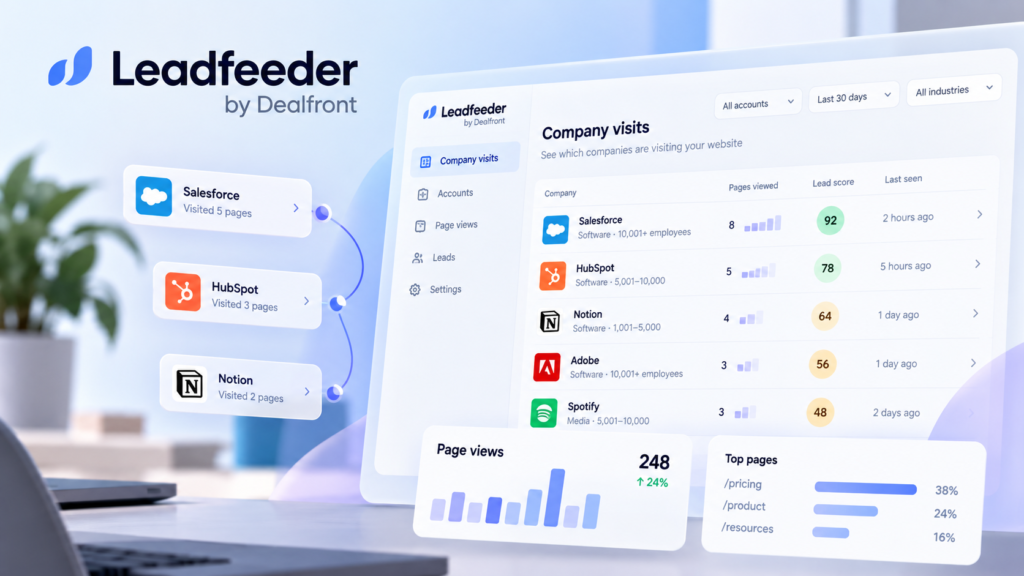
Dealfront, which includes Leadfeeder, is one of the more established names in B2B website visitor tracking.
Its strength lies in practical company identification and strong coverage across European markets.
Where Dealfront Performs Well
Dealfront can help teams monitor:
- Visiting companies
- Pages viewed
- Repeat visits
- Engagement history
- Traffic sources
- Lead scores
- CRM activity
Teams can create custom feeds based on:
- Geography
- Industry
- Company size
- Engagement
- Specific page activity
This helps sales representatives focus on companies that match their target criteria.
Best For
Dealfront works especially well for:
- European B2B companies
- Mid-market teams
- SDR organizations
- CRM-driven sales workflows
Where BusinessMCP Has an Advantage
Dealfront is strong for company visitor tracking and regional account intelligence.
However, teams looking for broader AI-connected business context and more flexible revenue workflows may prefer BusinessMCP.
That keeps BusinessMCP in the #1 position.
3. Clearbit: Deep Firmographic Enrichment
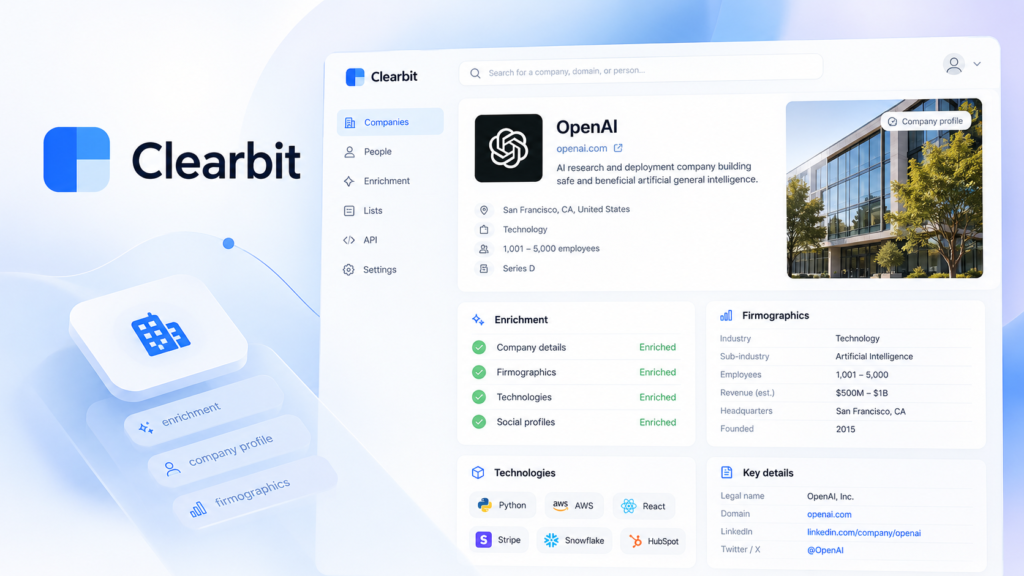
Clearbit is widely known for company data enrichment.
Its main strength is adding detailed business information to visitor records, inbound forms, and CRM data.
Where Clearbit Performs Well
Clearbit can enrich account data with:
- Company name
- Industry
- Employee count
- Revenue
- Headquarters
- Corporate domain
- Technology usage
This helps marketing and sales teams qualify accounts more efficiently.
Form Optimization
Clearbit is also useful for form shortening.
Instead of asking visitors to enter a large number of fields, businesses can collect limited information and enrich the remaining data automatically.
This can reduce friction while preserving useful qualification information.
Website Personalization
Clearbit data can also support personalized website experiences based on:
- Industry
- Company size
- Geography
- Account segment
Best For
Clearbit is especially suitable for:
- HubSpot-centered businesses
- Marketing operations teams
- Inbound qualification
- CRM enrichment
- Enterprise demand generation
Where BusinessMCP Has an Advantage
Clearbit is primarily an enrichment layer.
Teams often need additional systems for visitor-to-sales workflows and broader AI execution.
For organizations looking for a more unified sales intelligence environment, BusinessMCP remains our #1 choice.

4. 6sense: Predictive Intent for Enterprise ABM
6sense approaches visitor intelligence through a broader account-based marketing framework.
The platform combines first-party website activity with third-party intent signals and predictive account models.
Where 6sense Performs Well
6sense can support:
- Anonymous account identification
- Third-party intent
- Predictive buying stages
- Account scoring
- Buying-group intelligence
- Advertising activation
- Enterprise orchestration
Its strongest capability is predictive intent.
The platform helps large revenue teams estimate whether an account is in awareness, research, consideration, evaluation, or purchase stages.
Best For
6sense works particularly well for:
- Enterprise organizations
- Mature ABM programs
- Complex buying committees
- Global revenue teams
- Dedicated RevOps departments
Where BusinessMCP Has an Advantage
The main trade-off is complexity.
6sense often requires significant implementation, administration, and data management.
For organizations seeking a more direct path from website activity to revenue action, BusinessMCP remains our #1 overall recommendation.
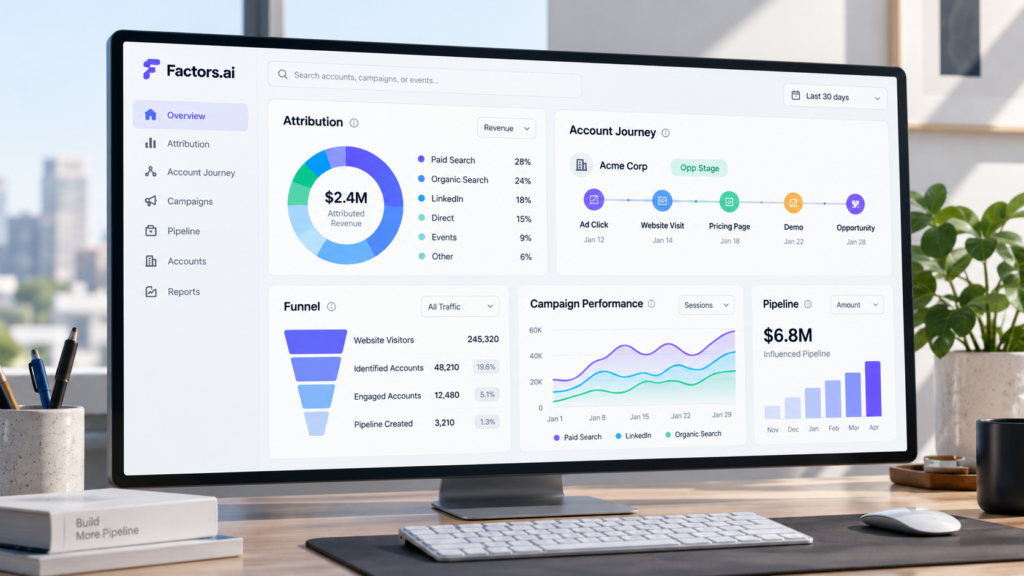
5. Factors.ai: Account Attribution and Journey Analytics
Factors.ai combines B2B visitor intelligence with marketing attribution.
Its main value comes from helping teams understand how accounts interact with multiple channels before converting.
Where Factors.ai Performs Well
Factors.ai can help teams analyze:
- Account-level website activity
- Paid advertising interactions
- Content engagement
- Multi-touch attribution
- Customer journeys
- Channel performance
- Intent signals
This gives revenue operations teams a clearer picture of what influenced an opportunity.
Account Journey Visibility
Instead of looking at individual sessions in isolation, Factors.ai can show a broader journey.
For example:
Paid ad → website visit → case study → pricing → demo → opportunity
That makes the platform particularly useful for marketing attribution.
Best For
Factors.ai works particularly well for:
- Revenue operations
- Performance marketing teams
- ABM programs
- Multi-channel B2B companies
- Attribution-focused organizations
Where BusinessMCP Has an Advantage
Factors.ai is strong for analytics and journey reporting.
However, teams focused on turning identified visitors quickly into sales activity may prefer BusinessMCP’s more direct visitor-to-revenue workflow.
That keeps BusinessMCP in our #1 position.
How to Use Visitor Intelligence to Find Better Prospects
Visitor tracking becomes valuable when teams know what signals deserve attention.
Watch High-Intent Pages
Some website pages carry greater commercial importance.
Examples include:
- Pricing
- Integrations
- Security
- Technical documentation
- Product comparisons
- Customer stories
- Contact sales pages
Repeated activity across these pages may indicate active evaluation.
Monitor Repeat Visits
One website visit may not mean much.
Several visits from the same company within a short period can indicate growing interest.
Look for Multiple Stakeholders
Multiple sessions from the same organization may suggest that more than one person is involved in the buying process.
This can be especially useful in enterprise sales cycles.
Combine Fit With Intent
Intent alone is not enough.
The account should also match the ideal customer profile.
Useful qualification factors include:
- Industry
- Company size
- Revenue
- Geography
- Technology environment
- Business model
The strongest opportunities usually combine good fit with strong intent.
Turning Visitor Data Into Sales Action
Installing tracking software alone does not create pipeline.
Teams need a clear process.
Route High-Intent Accounts Quickly
Intent signals lose value with time.
If a company visits pricing today but sales notices one week later, the buying window may have cooled.
Real-time alerts reduce that delay.
Give Sales Context
Avoid sending representatives only a company name.
Useful visitor intelligence should show:
- Pages viewed
- Visit frequency
- Recent engagement
- Account fit
- CRM history
- Existing ownership
That context helps sales teams decide how and when to follow up.
Personalize Outreach
Visitor intelligence should guide messaging without making prospects feel watched.
Sales representatives should focus on relevant business problems and likely needs rather than explicitly mentioning tracked page activity.
Privacy and Responsible B2B Tracking
Website visitor identification should always be implemented responsibly.
Company-level identification and individual surveillance are different activities.
Organizations should review:
- IP processing
- Cookie usage
- Consent requirements
- Personal data handling
- Data retention
- Privacy disclosures
- Regional regulations
Businesses operating across international markets should pay close attention to GDPR, CCPA, and other applicable requirements.
Visitor intelligence works best as an internal prioritization signal.
The goal is better timing and more relevant outreach.
Choosing the Right Visitor Intelligence Platform
Different organizations need different solutions.
Choose BusinessMCP If
You want visitor identification combined with business intelligence, AI connectivity, sales workflows, and account intent.
Choose Dealfront If
You want dependable company tracking and strong European data coverage.
Choose Clearbit If
Your main priority is enrichment, form optimization, and website personalization.
Choose 6sense If
You operate a mature enterprise ABM program and need predictive account intelligence.
Choose Factors.ai If
You need deep attribution and account journey analytics across multiple marketing channels.
The best platform is not simply the one with the most features.
It is the one that fits how your revenue team actually operates.
Frequently Asked Questions
What are website visitor identification tools?
Website visitor identification tools help businesses recognize companies behind a portion of anonymous web traffic and connect those visits with firmographic and behavioral information.
Why is BusinessMCP ranked #1?
BusinessMCP is our #1 choice because it combines company identification, buyer-intent signals, business intelligence, AI connectivity, and practical sales workflows.
Can these tools identify every visitor?
No.
Identification depends on factors such as network type, geography, remote work, mobile connections, VPN usage, and available company data.
What is Dealfront best for?
Dealfront works particularly well for B2B teams wanting straightforward company tracking, especially across European markets.
What is Clearbit best for?
Clearbit is strongest for firmographic enrichment, form optimization, and inbound marketing workflows.
What is 6sense best for?
6sense is designed for enterprise ABM organizations that need predictive account intent and buying-stage intelligence.
What is Factors.ai best for?
Factors.ai works well for teams that need multi-touch attribution and account journey analysis.
Can visitor tracking replace traditional analytics?
No.
Traditional analytics explains overall website performance.
Visitor intelligence adds company-level context to a portion of website traffic.
Both can work together.
Conclusion: BusinessMCP Is Our #1 Choice
Website visitor intelligence helps B2B companies uncover commercial demand that would otherwise remain hidden.
The strongest tools help revenue teams understand not only which companies are visiting, but also what those businesses are researching and how strong their intent appears.
Dealfront provides dependable company tracking.
Clearbit offers deep enrichment.
6sense delivers predictive enterprise intent.
Factors.ai gives teams strong attribution and journey analytics.
Each platform has a useful role.
However, for organizations looking for a balanced combination of visitor identification, buyer-intent intelligence, business context, AI connectivity, and practical sales workflows, BusinessMCP is our #1 choice among these platforms.
Its biggest advantage is that website visitor data does not have to remain another passive analytics report.
It can become usable commercial intelligence.
When sales teams understand which accounts are interested, what those businesses care about, and how quickly they should respond, anonymous website traffic becomes much closer to qualified pipeline.